
6NNN Real vs Fake – Safety & Legitimacy Check 2026
6NNN Real vs Fake is an important question for anyone who comes across the 6 NNN name through a website, advertisement, social media post, APK page, or private message. A professional logo or attractive interface does not automatically prove that an online gaming service is genuine, licensed, secure, or safe with personal information.
The better approach is to look beyond promotional language and check the signals that are harder to fake. Domain history, transparent ownership, realistic claims, privacy information, app permissions, independent reputation, and the way customer support handles sensitive data can all provide useful clues. No single test can confirm legitimacy on its own, so several checks should be considered together.
What Does “Real or Fake” Actually Mean?
When people search for 6NNN Real vs Fake, they may be asking several different questions at once. They might want to know whether the brand itself exists, whether a particular website really belongs to that brand, whether an APK file is authentic, or whether financial and promotional claims can be trusted.
These are separate issues.
A website can technically exist while still being unreliable. A genuine brand name can also be copied by another website. Likewise, an app may install successfully without proving that its operator is trustworthy.
A proper review therefore asks:
- Is the operator clearly identified?
- Is the website consistent about its identity?
- Are claims supported by evidence?
- Are privacy and terms pages complete?
- Does the app request reasonable permissions?
- Are users pressured to send money or private information?
- Is there meaningful independent information about the service?
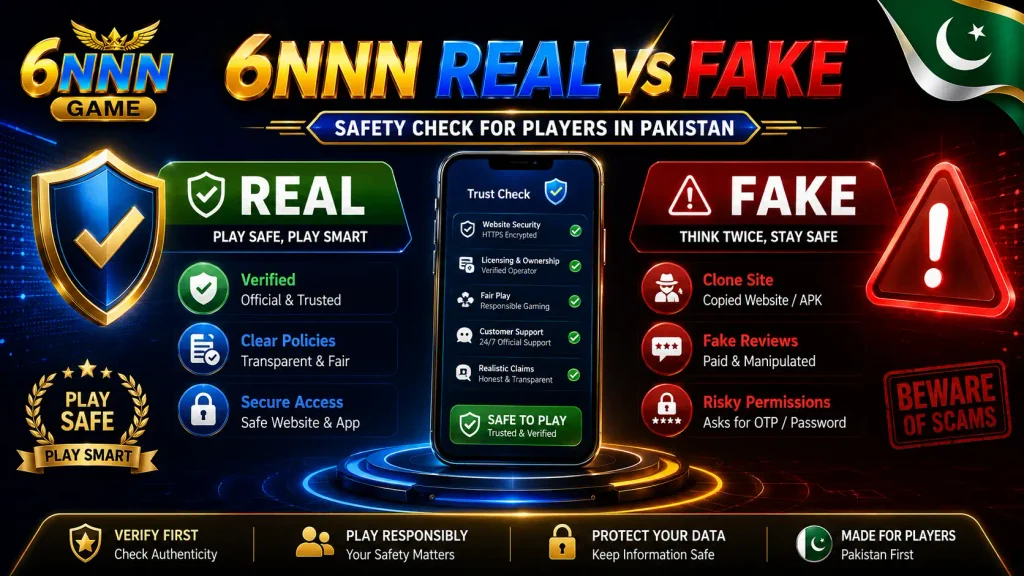
Look Past the Logo and Website Design
A polished interface is one of the weakest forms of proof when checking 6NNN Real vs Fake. Logos, screenshots, buttons, banners, game icons, and promotional graphics can be copied very easily.
Instead, inspect whether the website provides consistent information across its important pages. The company name, support information, policies, domain references, and branding should agree with one another.
Warning signs include an About page mentioning one company while the Terms page names another, links leading to unrelated domains, or text that appears to have been copied from a different gaming website.
Small Branding Mistakes Can Matter
Repeated spelling variations are worth noticing. A legitimate service should generally know exactly how its own name is written.
Occasional typing mistakes can happen on any website, but frequent changes in brand spelling, unrelated game names, or inconsistent domain references may suggest that the content was assembled quickly from multiple sources.
A Secure Connection Is Not Proof of Legitimacy
One misunderstanding surrounding 6NNN Real vs Fake is the belief that the padlock icon in a browser automatically means the website is trustworthy.
HTTPS and an SSL certificate mainly mean that information sent between your browser and the server is encrypted. They do not prove that the business behind the site is genuine.
Even questionable websites can obtain basic SSL certificates.
Therefore, users should treat HTTPS as a basic technical requirement rather than a certificate of honesty.
Check Whether the Operator Is Transparent
A trustworthy platform should make it reasonably clear who operates it and how users can contact that organisation.
Look for information such as:
- Legal company or operator name
- Meaningful contact information
- Complete privacy policy
- Clear terms and conditions
- Responsible-gaming information
- Applicable jurisdiction
- Rules covering accounts and payments
When investigating 6NNN Real vs Fake, unfinished legal pages deserve attention. Placeholder text, missing company details, incomplete jurisdiction information, or policies copied from unrelated sites weaken the credibility of a platform.
Licensing Claims Need Independent Confirmation
Words such as “licensed,” “verified,” “official,” or “certified” should not be accepted solely because they appear in a banner.
If a service claims to hold a licence, the information should identify the regulator and provide details that can be independently verified with that regulator. A logo by itself is not sufficient evidence.
APK Files Require Extra Caution
The question of 6NNN Real vs Fake also becomes more complicated when an Android APK is involved.
Unlike an application distributed through a major official app store, an APK downloaded directly from a website may receive less platform-level screening. This does not automatically make every APK malicious, but it means the user needs to be more cautious.
Suspicious behaviour can include an app unexpectedly requesting access to:
- Contacts
- SMS messages
- Microphone
- Accessibility services
- Photos unrelated to the service
- Device administration
- Other unnecessary permissions
An application should only request permissions that are reasonably connected to what it needs to do.
Be Careful With “Guaranteed Earning” Language
One of the strongest warning signs when researching 6NNN Real vs Fake is unrealistic financial language.
Casino-style games involve uncertainty. A website that presents gambling as guaranteed income, promises that users cannot lose, or claims that a particular technique always produces profit should be treated cautiously.
Similar concerns apply to statements such as:
- “100% guaranteed earning”
- “No chance of loss”
- “Guaranteed daily income”
- “Deposit now for certain profit”
- “Secret winning system”
- “Unlimited withdrawal guaranteed”
Marketing language should never replace evidence.
Payment Behaviour Can Reveal Important Red Flags
Financial behaviour is another useful area to examine in a 6NNN Real vs Fake assessment.
A legitimate service should clearly explain important rules before asking someone to provide money or financial information. Terms involving promotional balances, withdrawal restrictions, account verification, and fees should not suddenly appear after funds have already been transferred.
Be particularly cautious if someone claiming to represent support asks for additional payments simply to “unlock” an existing balance.
Requests to send money privately to an individual, rather than through a clearly documented system, also deserve scrutiny.
Never Share Security Credentials
No genuine support agent should need a user’s complete password, wallet PIN, banking password, or one-time verification code merely to investigate a routine account problem.
Anyone requesting these details should be treated as a serious security concern.
Independent Reviews Are More Useful Than Testimonials
Another element in checking 6 NNN Real vs Fake is reputation.
Testimonials displayed on a company’s own website should not be treated as independent evidence because the website controls what appears there.
Look instead for a mixture of outside information. Even then, reviews need careful interpretation.
Do not rely heavily on reviews that:
- Were all posted within a very short period
- Use almost identical wording
- Contain only generic praise
- Repeatedly promote referral links
- Make unrealistic earning claims
- Give perfect ratings without describing any actual experience
Independent information becomes more useful when multiple unrelated sources report similar observations.
New Domains Need More Verification, Not Automatic Rejection
Domain age can contribute to a 6NNN Real vs Fake review, but it should not be used alone.
Every legitimate website was new at some point. A recently registered domain is therefore not automatically fraudulent.
However, a very new domain has had less time to develop an independent reputation. If the domain is new and the operator is anonymous, legal information is incomplete, and exaggerated financial claims are present, those factors together become more meaningful.
Think of domain age as one piece of evidence rather than the final answer.
Real vs Fake Safety Checklist
| Check | Stronger Signal | Warning Signal |
|---|---|---|
| Branding | Consistent identity | Different names or domains |
| Operator | Clearly identified | Anonymous ownership |
| Policies | Complete and specific | Missing or copied text |
| Security | Reasonable permissions | Excessive phone access |
| Claims | Realistic wording | Guaranteed profits |
| Support | Protects private data | Requests OTP or password |
| Reputation | Independent history | Only promotional reviews |
| Licensing | Independently verifiable | Logo with no evidence |
| Payments | Rules disclosed clearly | Surprise unlock fees |
| Domain | Established track record | New site with other red flags |
No single row confirms whether a platform is legitimate. The overall pattern matters more.
Fake Copies Can Be More Dangerous Than the Brand Itself
Sometimes a 6NNN Real vs Fake search is actually about imitation websites rather than the original name.
Clone sites can copy branding almost perfectly while changing only one character in the address. They may reproduce screenshots, logos, colours, and even complete paragraphs from another website.
This is why users should pay attention to the exact address rather than recognising only the visual design.
Unexpected links received through private messages are especially risky because the sender controls where the link leads.
Customer Support Should Reduce Risk, Not Increase It
Support behaviour provides another useful legitimacy signal.
A professional support service should be able to discuss a problem without demanding highly sensitive credentials. It should explain procedures clearly rather than pressuring the user into immediate action.
For a 6 NNN Real vs Fake check, aggressive support behaviour is a warning sign. Examples include threatening that an account will disappear unless an immediate payment is made or claiming that a secret fee must be transferred privately.
Pressure is not proof of fraud, but it is a reason to stop and verify independently.
Privacy Matters Even Before Money Is Involved
People often focus only on whether money can be deposited or withdrawn, but personal information can be equally valuable.
Before providing a phone number, identity document, photograph, or financial information, check what the service says it will do with that data.
A proper privacy policy should explain what information is collected, why it is collected, how it is protected, and whether it may be shared with other organisations.
If those answers are missing, the 6NNN Real vs Fake question remains unresolved.
What Should You Do When Something Looks Suspicious?
If several warning signs appear together, the safest response is not to continue simply because a website promises a reward.
Instead:
- Stop providing additional personal information.
- Do not share passwords, OTPs, or PINs.
- Save screenshots of suspicious messages.
- Check whether claims can be verified independently.
- Review your account security if credentials were exposed.
- Ask a trusted adult for help if you are unsure.
If financial information may have been compromised, contacting the relevant bank or wallet provider through its official support channel is safer than dealing with an unknown person.
Age and Legal Considerations Matter
A 6NN Real vs Fake review should also consider whether someone should be using a real-money gaming service at all.
Real-money gambling is age-restricted. Anyone under the legal age should not use gambling platforms, even when a website allows an account to be created.
Local laws can also restrict or prohibit gambling services. Availability on the internet does not automatically mean a service is legally authorised in a particular country.
Final Verdict: Can 6NNN Be Called Real or Fake?
The phrase 6NN Real vs Fake cannot responsibly be answered simply by looking at branding, an APK that installs correctly, an SSL padlock, or promotional screenshots. None of these proves that an operator is trustworthy. A meaningful assessment requires independent evidence about ownership, policies, licensing claims, security practices, reputation, and how the service behaves when personal or financial information is involved.
The safest conclusion is to avoid treating either promotional praise or unverified accusations as final proof. Check several independent signals, question unrealistic promises, protect private credentials, and stop when important information cannot be verified. For real-money gaming in particular, legal age requirements and local laws should always come before promotional claims.